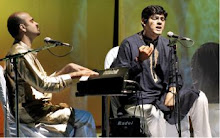
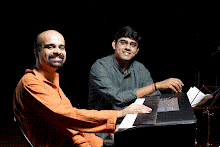
My website www.anilsrinivasan.com
is ready and waiting to be explored. Do check out the music links at Gallery > My Music.
More soon.
Wednesday, February 18, 2009


Wednesday, September 10, 2008
Sunday, August 24, 2008
Latest Article
http://www.newindpress.com/sunday/sundayitems.asp?id=SEA20080823165441&eTitle=Arts&rLink=0
Tuesday, July 29, 2008
An article on Ravikiran
http://www.newindpress.com/sunday/sundayitems.asp?id=SEA20080719112042&eTitle=Arts&rLink=0
Dancing to Different Melodies
ANIL SRINIVASAN
So everyone is talking about China and India. I remember every discussion in business school having both these names mentioned as though they were one phrase, like “salt and pepper”. And that is where the divergence begins to grate on my sensibilities, because no two systems of thought could be more different. Separated by a stretch of mountain, glacial systems and desert, these two neighbours have progressed to the accompaniment of different rhythmic clocks. So much so that our musical systems share very few aspects in common. However, a slightly deeper analysis of the musical structures in authentic Chinese melodies reveals certain amazing coincidences.
The Youlan (by Confucius) is supposed to be the earliest chronicled musical work in Chinese musical literature. Listening to it being rendered with a Yanqin (our “santoor”) and the pipa (a fretless lute) brings forth a certain set of characteristics that hold a common ground. For instance, the prevalence of melody set to a certain rhythm cycle (Chinese music seems to have an abundance of 3, 4 and 7 count cycles– tishram, chatushram and mishram respectively) is similar to classical forms everywhere, particularly ours. The melodic tone used (usually whole tones, avoiding chromatics or sharp notes) reminds me very much of scale-changes on the Carnatic raga “Mohanam”. Shifting the opening note of Raga Mohanam brings forth new ragams – Madhyamavati, Hindolam, Shudda Sarang and so on. All of these ragams (and some more, such as Shudda Saveri) have pentatonic systems. These magical five notes can evoke moods, variations in ambience and a wealth of musical textures. Both the Chinese and the Indian music systems have honed in on these notes and their incumbent variations.
However, at least to a mind untrained to look beyond such superficial resemblances, this is where the bridge collapses. While the Indian classical music systems have traversed great distances into the ocean of sound, I find that Chinese music treats improvisation with less importance than an adherence to form and discipline. There is freedom in the use of form and melodic line in the Indian imagination, which somehow seems a trifle curtailed across the border. This is interesting given where the influences of each of these musical systems (Indian and Chinese) come from. While spiritual antecedents, hymnal chanting and a detailed codification and indigenous grammar characterized South Indian classical music, the North Indian forms gathered influences from foreign incursions, notably from Persia and Central Asia. Some of these Central Asians have influenced the Chinese as well, probably evidenced by the pentatonic melodies common across our borders. However, the entry of the Western musicians (first in the 17th Century in China, and later through much of the Cultural Revolution and the rise of communism) has seen regimentation in Chinese music with respect to form and content. Indeed, most large Chinese cities boast of symphony orchestras of a standard comparable to those in New York or Vienna. However, the emphasis is more on structure.
I am certainly not trying to paint a certain system of musical thought in an inferior light. Indeed, I am ill-equipped to judge another melodic system without a more in-depth analysis of its rudiments and structural character. However, when I think of Yo-Yo Ma (the renowned cellist) or Lang Lang ( a world famous western classical pianist), I see the indelible influence of the West.
Certain structural characteristics of the Western classical form must have appealed to the revolutionary Chinese in the mid-20th century. Collective adherence to form (in the case of ensemble playing or orchestral arrangements) and interpreting music strictly by design (using the composer as the guide, and restricting the scope for individual self-expression) seems to be reflective of a culture that was trying to establish discipline and a common code of cultural discovery. In India, just as in every other sphere of human endeavour, the triumph of multiplicity and individualist notions seems apparent in music as well.
Perhaps the China that is now gearing itself globally in terms of its economics will embrace a more individualist spirit, and these will be exciting times for Indian musicians to collaborate freely and enrich the cultural template of this part of the world, especially material drawn from the folk traditions of the two countries.
For now, I am content keeping the two systems of musical thought separate. Copyright New Sunday Express
ANIL SRINIVASAN
So everyone is talking about China and India. I remember every discussion in business school having both these names mentioned as though they were one phrase, like “salt and pepper”. And that is where the divergence begins to grate on my sensibilities, because no two systems of thought could be more different. Separated by a stretch of mountain, glacial systems and desert, these two neighbours have progressed to the accompaniment of different rhythmic clocks. So much so that our musical systems share very few aspects in common. However, a slightly deeper analysis of the musical structures in authentic Chinese melodies reveals certain amazing coincidences.
The Youlan (by Confucius) is supposed to be the earliest chronicled musical work in Chinese musical literature. Listening to it being rendered with a Yanqin (our “santoor”) and the pipa (a fretless lute) brings forth a certain set of characteristics that hold a common ground. For instance, the prevalence of melody set to a certain rhythm cycle (Chinese music seems to have an abundance of 3, 4 and 7 count cycles– tishram, chatushram and mishram respectively) is similar to classical forms everywhere, particularly ours. The melodic tone used (usually whole tones, avoiding chromatics or sharp notes) reminds me very much of scale-changes on the Carnatic raga “Mohanam”. Shifting the opening note of Raga Mohanam brings forth new ragams – Madhyamavati, Hindolam, Shudda Sarang and so on. All of these ragams (and some more, such as Shudda Saveri) have pentatonic systems. These magical five notes can evoke moods, variations in ambience and a wealth of musical textures. Both the Chinese and the Indian music systems have honed in on these notes and their incumbent variations.
However, at least to a mind untrained to look beyond such superficial resemblances, this is where the bridge collapses. While the Indian classical music systems have traversed great distances into the ocean of sound, I find that Chinese music treats improvisation with less importance than an adherence to form and discipline. There is freedom in the use of form and melodic line in the Indian imagination, which somehow seems a trifle curtailed across the border. This is interesting given where the influences of each of these musical systems (Indian and Chinese) come from. While spiritual antecedents, hymnal chanting and a detailed codification and indigenous grammar characterized South Indian classical music, the North Indian forms gathered influences from foreign incursions, notably from Persia and Central Asia. Some of these Central Asians have influenced the Chinese as well, probably evidenced by the pentatonic melodies common across our borders. However, the entry of the Western musicians (first in the 17th Century in China, and later through much of the Cultural Revolution and the rise of communism) has seen regimentation in Chinese music with respect to form and content. Indeed, most large Chinese cities boast of symphony orchestras of a standard comparable to those in New York or Vienna. However, the emphasis is more on structure.
I am certainly not trying to paint a certain system of musical thought in an inferior light. Indeed, I am ill-equipped to judge another melodic system without a more in-depth analysis of its rudiments and structural character. However, when I think of Yo-Yo Ma (the renowned cellist) or Lang Lang ( a world famous western classical pianist), I see the indelible influence of the West.
Certain structural characteristics of the Western classical form must have appealed to the revolutionary Chinese in the mid-20th century. Collective adherence to form (in the case of ensemble playing or orchestral arrangements) and interpreting music strictly by design (using the composer as the guide, and restricting the scope for individual self-expression) seems to be reflective of a culture that was trying to establish discipline and a common code of cultural discovery. In India, just as in every other sphere of human endeavour, the triumph of multiplicity and individualist notions seems apparent in music as well.
Perhaps the China that is now gearing itself globally in terms of its economics will embrace a more individualist spirit, and these will be exciting times for Indian musicians to collaborate freely and enrich the cultural template of this part of the world, especially material drawn from the folk traditions of the two countries.
For now, I am content keeping the two systems of musical thought separate. Copyright New Sunday Express
Wednesday, July 9, 2008
Rahmania
The Indian Musical Spirit
ANIL SRINIVASAN
I am going to gush about A R Rahman in this article. Not just because he is the most talented music director and arranger on the block but just simply because he has done us all a phenomenal service – he has proven that we can, as a nation of music-loving, music-making people, find a delicate balance. This is not merely a balancing of styles, tastes and preferences but of perspectives. He has made it possible for us to have the music of our times presented in such a well-organized, classy package. No fuss or frills, but well-conceived music delivered with aplomb. It manages the quintessential amount of lyrical classicism with absolutely edgy, grip-the-corner-of-your-seat contemporaneity. Listening to his music makes me think of yellow autos on New York streets, and skyscrapers reaching the sky in Mylapore all at once. The beauty lies in the fact that Rahman makes such zany collages seem plausible.
I am listening to the track “Kabhi Kabhi Aditi” from Jaane Tu.. on my personal stereo. It is peppy and uplifting. However, what I love about it is its ability to traverse across style and mindsets. It has a moving bass that can appeal to the younger audience, a tidily crafted melodic line that can move the more musically oriented and it has lyrics that are clean, crisply rendered and quite adorable. The overall effect, including the detailing of various nuances of Rashid Ali’s voice (who, if he is reading this, should know he has found a very loyal fan) in the repetitive alaaps in the end are precisely monitored.
I do not know if everyone agrees with this observation, but Rahman is not merely a craftsman representing our spirit. He is the spirit. This is India now, a microcosm of several styles and cultures peppered with tradition and bursting with confidence. This is the India that moves on horizontal time, each individual leading multiple lives and careers. It is the India that believes in possibilities and alternatives, and no longer rushes to linear conclusions to every decision problem. Each of these Indias find an echo in Rahman’s music score. With their juxtapositions of different styles, the mixtures of varied voices and the ever-present surprise element in each song ( a guitar riff that sounds different, a voice that sounds unique or an instrument one does not associate with a certain mood), Rahman’s music truly accompanies the rhythms of our extremely colourful modern-day reality. When Rahman attempts a remix (try “Pon Magal Vandhal” from Azhagiya Tamizh Magan), it still exceeds expectations. A classical infusion (like, “Narumugaye” from Iruvar) works equally well, and an all-out ‘dance the night away’ number (like a “Fanaa” from Yuva) proves difficult to dismiss easily.
When I saw the publicity material for Bombay Dreams near Columbus Circle in New York two years ago, my heart gave a lurch. On that unaccustomed earth, with the wind swirling the temperature down to sub zero, I still felt my face grow warm watching the Broadway crowd crowding up to get tickets to watch an Indian production. Having lived in the United States at a time that world attitude towards all things Indian gradually went through a transformation (from “poor nation with potential” to “knowledge experts and entertainment gurus”), I found Rahman’s music to be a fitting companion score to India’s zeitgeist.
In my ongoing crusade to excite more composers of original sound, and the need for Indian musicians ( classical, film, whatever) to expose themselves to as many global influences and thought processes as possible, I find myself returning to Rahman’s music as perhaps the most important development in Indian sound in a long time. India is a truly global player and its music should be elevated to the greatest heights possible. With our own, extremely evolved classical grammar and our natural curiosity to adapt and assimilate with the global community, I think that the possibilities for Indian music are as expansive as our collective imagination.
Copyright New Sunday Express
ANIL SRINIVASAN
I am going to gush about A R Rahman in this article. Not just because he is the most talented music director and arranger on the block but just simply because he has done us all a phenomenal service – he has proven that we can, as a nation of music-loving, music-making people, find a delicate balance. This is not merely a balancing of styles, tastes and preferences but of perspectives. He has made it possible for us to have the music of our times presented in such a well-organized, classy package. No fuss or frills, but well-conceived music delivered with aplomb. It manages the quintessential amount of lyrical classicism with absolutely edgy, grip-the-corner-of-your-seat contemporaneity. Listening to his music makes me think of yellow autos on New York streets, and skyscrapers reaching the sky in Mylapore all at once. The beauty lies in the fact that Rahman makes such zany collages seem plausible.
I am listening to the track “Kabhi Kabhi Aditi” from Jaane Tu.. on my personal stereo. It is peppy and uplifting. However, what I love about it is its ability to traverse across style and mindsets. It has a moving bass that can appeal to the younger audience, a tidily crafted melodic line that can move the more musically oriented and it has lyrics that are clean, crisply rendered and quite adorable. The overall effect, including the detailing of various nuances of Rashid Ali’s voice (who, if he is reading this, should know he has found a very loyal fan) in the repetitive alaaps in the end are precisely monitored.
I do not know if everyone agrees with this observation, but Rahman is not merely a craftsman representing our spirit. He is the spirit. This is India now, a microcosm of several styles and cultures peppered with tradition and bursting with confidence. This is the India that moves on horizontal time, each individual leading multiple lives and careers. It is the India that believes in possibilities and alternatives, and no longer rushes to linear conclusions to every decision problem. Each of these Indias find an echo in Rahman’s music score. With their juxtapositions of different styles, the mixtures of varied voices and the ever-present surprise element in each song ( a guitar riff that sounds different, a voice that sounds unique or an instrument one does not associate with a certain mood), Rahman’s music truly accompanies the rhythms of our extremely colourful modern-day reality. When Rahman attempts a remix (try “Pon Magal Vandhal” from Azhagiya Tamizh Magan), it still exceeds expectations. A classical infusion (like, “Narumugaye” from Iruvar) works equally well, and an all-out ‘dance the night away’ number (like a “Fanaa” from Yuva) proves difficult to dismiss easily.
When I saw the publicity material for Bombay Dreams near Columbus Circle in New York two years ago, my heart gave a lurch. On that unaccustomed earth, with the wind swirling the temperature down to sub zero, I still felt my face grow warm watching the Broadway crowd crowding up to get tickets to watch an Indian production. Having lived in the United States at a time that world attitude towards all things Indian gradually went through a transformation (from “poor nation with potential” to “knowledge experts and entertainment gurus”), I found Rahman’s music to be a fitting companion score to India’s zeitgeist.
In my ongoing crusade to excite more composers of original sound, and the need for Indian musicians ( classical, film, whatever) to expose themselves to as many global influences and thought processes as possible, I find myself returning to Rahman’s music as perhaps the most important development in Indian sound in a long time. India is a truly global player and its music should be elevated to the greatest heights possible. With our own, extremely evolved classical grammar and our natural curiosity to adapt and assimilate with the global community, I think that the possibilities for Indian music are as expansive as our collective imagination.
Copyright New Sunday Express
Friday, June 27, 2008
Part time or Pastime
Part-time or Pastime
ANIL SRINIVASAN
I had emails from several readers requesting me to keep my columns simpler and less serious, and so I decided to start this week's piece on a different subject. And so I focus on myself, and why I have come to love music more than anything else in the world. This is an easy topic for me to be humorous about, but extremely difficult to write nonetheless. So hopefully, some of those confessions might make you all think of the role music has had to play in your own lives. So here goes.
I am 31 years old. I am reasonably bright, and I like well-ordered things, drinking tea at odd hours and reading a lot. I went abroad and had the benefit of a great education. Unlike many of my peers, I decided to come back as soon as I finished my education. The energy Chennai has managed to create is irresistible, as only those who have come rushing back will know. I make music, teach and consult, and am considered fairly competent on all of those things. More importantly, I love every one of these activities and engage in them whole-heartedly. So far, so good.
At a conference last year, I was among many musicians registering dissent when a prominent classical musician announced to the gallery that those involved in anything less than a 24 hour pursuit of classical music ought not to call themselves musicians. Those who straddled music alongside careers in the corporate world were "hobby musicians" or "pastimers", she argued. Perhaps this is true to some extent, considering the economic sacrifices many of the greatest musical names through history have made in favour of a full-time dedication to the one thing they adored. But "pastimers" as a descriptor refused to sit well with me, and this leads me to the crux of today's essay.
The pursuit of music, regardless of the time one devotes to it, requires seriousness on the part of the executor. It commands absolute surrender. Music is seldom an "outcome", and this becomes evident the moment my fingers start moving on the keys. It becomes a journey with several routes to traverse, unexpected surprises assaulting one's consciousness at every turn. To the listener, this particular set of notes may resemble a composition but to me, it is always an exploration into the unknown. I am barely conscious of what I am playing. As in meditation, I can only focus on the breathing. In this case, it becomes the unguided automaticity of skin on enamel, finger on key, heart on string. An outcome happens to get crafted at the end of the exercise. I often surprise myself when I listen to recordings of my playing as I rarely remember specific phrases or patterns I have played.
On the flip side, I actually find that my life in the "outside world" often helps in this process of musical discovery. To me, my parallel pursuits offer a different perspective on structures, emotionality and form. For instance, at a concert in Bangalore with Chitravina Ravikiran, I found myself harmonizing a certain phrase in contrary progressions – a system of chords in which the intervals between any two concurrently played notes of a single chord increase progressively ( so, the main melodic note is accompanied first by a note on the third place from it, then the fourth from it and so on in the right hand (i.e. 1-3, 1-4, 1-5…) while the left hand starts with the seventh note from the initial note and comes progressively closer(7-1, 6-1, 5-1 etc.). When I thought about this later, it struck me that this idea for harmonics came from studying a bar chart at work, when two histograms of opposing rates of growth had been juxtaposed against each other. This was not a premeditated idea, merely an unconscious application of my wandering mind.
Every time I approach my instrument, I set off reflexes that have become conditioned with time and age. I feel nervousness, excitement and a rush of adrenalin without having to control these processes. These reflexes are unmarred by anything that I do while not actively engaging with music. On the contrary, the human interactivity and enforced adaptability of other domains provides me immense relief, a balanced perspective and increasingly, some interesting ideas.
I do not say this to exhort those engaged in music full-time to apply for corporate jobs. With due respect, all I submit for consideration is the possibility that a life that constantly travels between domains absorbs many good things from each of these domains. Osmosis is integral to my performance in the non-musical realm as well. I often find that my approach to decision making in business has benefited greatly from my daily musical routine.
Ellington once said that there are two kinds of music in this world, the good kind and what he humorously termed "the other" kind. Whether music is part-time or pastime, I think the only hope for every musician (and only a musician knows himself to be who he is!) is to avoid making the latter!
Copyright The New Sunday Express
ANIL SRINIVASAN
I had emails from several readers requesting me to keep my columns simpler and less serious, and so I decided to start this week's piece on a different subject. And so I focus on myself, and why I have come to love music more than anything else in the world. This is an easy topic for me to be humorous about, but extremely difficult to write nonetheless. So hopefully, some of those confessions might make you all think of the role music has had to play in your own lives. So here goes.
I am 31 years old. I am reasonably bright, and I like well-ordered things, drinking tea at odd hours and reading a lot. I went abroad and had the benefit of a great education. Unlike many of my peers, I decided to come back as soon as I finished my education. The energy Chennai has managed to create is irresistible, as only those who have come rushing back will know. I make music, teach and consult, and am considered fairly competent on all of those things. More importantly, I love every one of these activities and engage in them whole-heartedly. So far, so good.
At a conference last year, I was among many musicians registering dissent when a prominent classical musician announced to the gallery that those involved in anything less than a 24 hour pursuit of classical music ought not to call themselves musicians. Those who straddled music alongside careers in the corporate world were "hobby musicians" or "pastimers", she argued. Perhaps this is true to some extent, considering the economic sacrifices many of the greatest musical names through history have made in favour of a full-time dedication to the one thing they adored. But "pastimers" as a descriptor refused to sit well with me, and this leads me to the crux of today's essay.
The pursuit of music, regardless of the time one devotes to it, requires seriousness on the part of the executor. It commands absolute surrender. Music is seldom an "outcome", and this becomes evident the moment my fingers start moving on the keys. It becomes a journey with several routes to traverse, unexpected surprises assaulting one's consciousness at every turn. To the listener, this particular set of notes may resemble a composition but to me, it is always an exploration into the unknown. I am barely conscious of what I am playing. As in meditation, I can only focus on the breathing. In this case, it becomes the unguided automaticity of skin on enamel, finger on key, heart on string. An outcome happens to get crafted at the end of the exercise. I often surprise myself when I listen to recordings of my playing as I rarely remember specific phrases or patterns I have played.
On the flip side, I actually find that my life in the "outside world" often helps in this process of musical discovery. To me, my parallel pursuits offer a different perspective on structures, emotionality and form. For instance, at a concert in Bangalore with Chitravina Ravikiran, I found myself harmonizing a certain phrase in contrary progressions – a system of chords in which the intervals between any two concurrently played notes of a single chord increase progressively ( so, the main melodic note is accompanied first by a note on the third place from it, then the fourth from it and so on in the right hand (i.e. 1-3, 1-4, 1-5…) while the left hand starts with the seventh note from the initial note and comes progressively closer(7-1, 6-1, 5-1 etc.). When I thought about this later, it struck me that this idea for harmonics came from studying a bar chart at work, when two histograms of opposing rates of growth had been juxtaposed against each other. This was not a premeditated idea, merely an unconscious application of my wandering mind.
Every time I approach my instrument, I set off reflexes that have become conditioned with time and age. I feel nervousness, excitement and a rush of adrenalin without having to control these processes. These reflexes are unmarred by anything that I do while not actively engaging with music. On the contrary, the human interactivity and enforced adaptability of other domains provides me immense relief, a balanced perspective and increasingly, some interesting ideas.
I do not say this to exhort those engaged in music full-time to apply for corporate jobs. With due respect, all I submit for consideration is the possibility that a life that constantly travels between domains absorbs many good things from each of these domains. Osmosis is integral to my performance in the non-musical realm as well. I often find that my approach to decision making in business has benefited greatly from my daily musical routine.
Ellington once said that there are two kinds of music in this world, the good kind and what he humorously termed "the other" kind. Whether music is part-time or pastime, I think the only hope for every musician (and only a musician knows himself to be who he is!) is to avoid making the latter!
Copyright The New Sunday Express
Subscribe to:
Posts (Atom)